ChatGPT and Translation
The following Japanese text is the opening passage of a novel by Natsume Soseki. Below it are a GPT-4 translation done on March 15, 2023, and the 2013 translation by William F. Sibley published by New York Review Books. (GPT-4 translates haiku here.)
Original:
宗助は先刻から縁側へ坐蒲団を持ち出して、日当りの好さそうな所へ気楽に胡坐をかいて見たが、やがて手に持っている雑誌を放り出すと共に、ごろりと横になった。秋日和と名のつくほどの上天気なので、往来を行く人の下駄の響が、静かな町だけに、朗らかに聞えて来る。肱枕をして軒から上を見上げると、奇麗な空が一面に蒼く澄んでいる。その空が自分の寝ている縁側の、窮屈な寸法に較べて見ると、非常に広大である。たまの日曜にこうして緩くり空を見るだけでもだいぶ違うなと思いながら、眉を寄せて、ぎらぎらする日をしばらく見つめていたが、眩しくなったので、今度はぐるりと寝返りをして障子の方を向いた。障子の中では細君が裁縫をしている。
「おい、好い天気だな」と話しかけた。細君は、
「ええ」と云ったなりであった。宗助も別に話がしたい訳でもなかったと見えて、それなり黙ってしまった。しばらくすると今度は細君の方から、
「ちっと散歩でもしていらっしゃい」と云った。しかしその時は宗助がただうんと云う生返事を返しただけであった。
二三分して、細君は障子の硝子の所へ顔を寄せて、縁側に寝ている夫の姿を覗いて見た。夫はどう云う了見か両膝を曲げて海老のように窮屈になっている。そうして両手を組み合わして、その中へ黒い頭を突っ込んでいるから、肱に挟まれて顔がちっとも見えない。
「あなたそんな所へ寝ると風邪引いてよ」と細君が注意した。細君の言葉は東京のような、東京でないような、現代の女学生に共通な一種の調子を持っている。
宗助は両肱の中で大きな眼をぱちぱちさせながら、
「寝やせん、大丈夫だ」と小声で答えた。
それからまた静かになった。外を通る護謨車のベルの音が二三度鳴った後から、遠くで鶏の時音をつくる声が聞えた。宗助は仕立おろしの紡績織の背中へ、自然と浸み込んで来る光線の暖味を、襯衣の下で貪ぼるほど味いながら、表の音を聴くともなく聴いていたが、急に思い出したように、障子越しの細君を呼んで、
「御米、近来の近の字はどう書いたっけね」と尋ねた。細君は別に呆れた様子もなく、若い女に特有なけたたましい笑声も立てず、
「近江のおうの字じゃなくって」と答えた。
「その近江のおうの字が分らないんだ」
細君は立て切った障子を半分ばかり開けて、敷居の外へ長い物指を出して、その先で近の字を縁側へ書いて見せて、
「こうでしょう」と云ったぎり、物指の先を、字の留った所へ置いたなり、澄み渡った空を一しきり眺め入った。宗助は細君の顔も見ずに、
「やっぱりそうか」と云ったが、冗談でもなかったと見えて、別に笑もしなかった。細君も近の字はまるで気にならない様子で、
「本当に好い御天気だわね」と半ば独り言のように云いながら、障子を開けたまままた裁縫を始めた。すると宗助は肱で挟んだ頭を少し擡げて、
「どうも字と云うものは不思議だよ」と始めて細君の顔を見た。
「なぜ」
「なぜって、いくら容易い字でも、こりゃ変だと思って疑ぐり出すと分らなくなる。この間も今日の今の字で大変迷った。紙の上へちゃんと書いて見て、じっと眺めていると、何だか違ったような気がする。しまいには見れば見るほど今らしくなくなって来る。――御前そんな事を経験した事はないかい」
「まさか」
「おれだけかな」と宗助は頭へ手を当てた。
「あなたどうかしていらっしゃるのよ」
「やっぱり神経衰弱のせいかも知れない」
「そうよ」と細君は夫の顔を見た。夫はようやく立ち上った。
GPT-4 (March 15, 2023)
Prompt: The following Japanese text is the opening passage of the novel 門 by Natsume Soseki. Translate this passage into natural and smooth modern English.
Sosuke had brought a cushion to the porch earlier, sat down leisurely in a sunny spot, and started reading a magazine. However, he soon tossed the magazine aside and lay down. It was a fine autumn day, and the sound of people walking by in their wooden sandals echoed pleasantly in the quiet neighborhood. Propping his head up on his arm, Sosuke looked up at the clear blue sky above the porch. The vast expanse of the sky seemed immense compared to the cramped dimensions of the porch. Enjoying this rare Sunday of relaxation, Sosuke squinted at the bright sun for a while, then turned over to face the paper sliding door.
His wife was sewing behind the door. "Hey, it's a beautiful day, isn't it?" he said. She simply replied, "Yes." Sosuke didn't seem to have anything else to say and fell silent. After a while, his wife suggested, "Why don't you go for a walk?" But Sosuke only gave a noncommittal grunt in response.
A few minutes later, his wife peered out through the glass panel in the sliding door to see Sosuke lying on the porch, curled up like a shrimp with his knees bent. His head was buried between his clasped hands, making it impossible to see his face. "If you sleep there, you'll catch a cold," she warned him. Her tone was a blend of Tokyo dialect and the modern female student's speech.
With his eyes wide open, Sosuke whispered, "I won't sleep, I'll be fine."
After that, silence fell again. The sound of a passing streetcar's bell rang a few times, followed by the crowing of a distant rooster. Sosuke enjoyed the warmth of sunlight that naturally seeped into the fabric of his freshly tailored cotton garment while absentmindedly listening to the noises outside. Suddenly, as if remembering something, he called out to his wife through the sliding door, "Hey, how do you write the 'near' kanji in 'recently' again?"
His wife, without showing any signs of exasperation or a characteristic high-pitched laugh of a young woman, replied, "You mean the 'Ou' in 'Omi', right?"
"That's the one I don't know."
His wife opened the sliding door halfway, reached out with her long index finger, and drew the kanji for 'near' on the porch, saying, "Like this?" She then left her fingertip on the spot where she had written the character and gazed at the clear sky for a while. Sosuke, without looking at his wife's face, said, "So it is like that." He didn't seem to be joking and didn't laugh. His wife, apparently uninterested in the kanji, said, "It really is a beautiful day," almost to herself, and resumed sewing with the door still open.
Sosuke then lifted his head slightly and looked at his wife's face for the first time. "Kanji is quite mysterious," he said.
"Why?"
"Well, even if it's a simple character, once you start doubting it, it becomes unrecognizable. The other day, I got terribly confused with the kanji for 'now.' When I stared at it written on paper, it started to seem wrong. The more I looked at it, the less it looked like 'now.' Have you ever experienced that?"
"Not at all."
"Is it just me, then?" Sosuke touched his forehead.
"You must be out of sorts."
"Maybe it's because of my neurasthenia."
"That could be it," his wife looked at Sosuke's face.
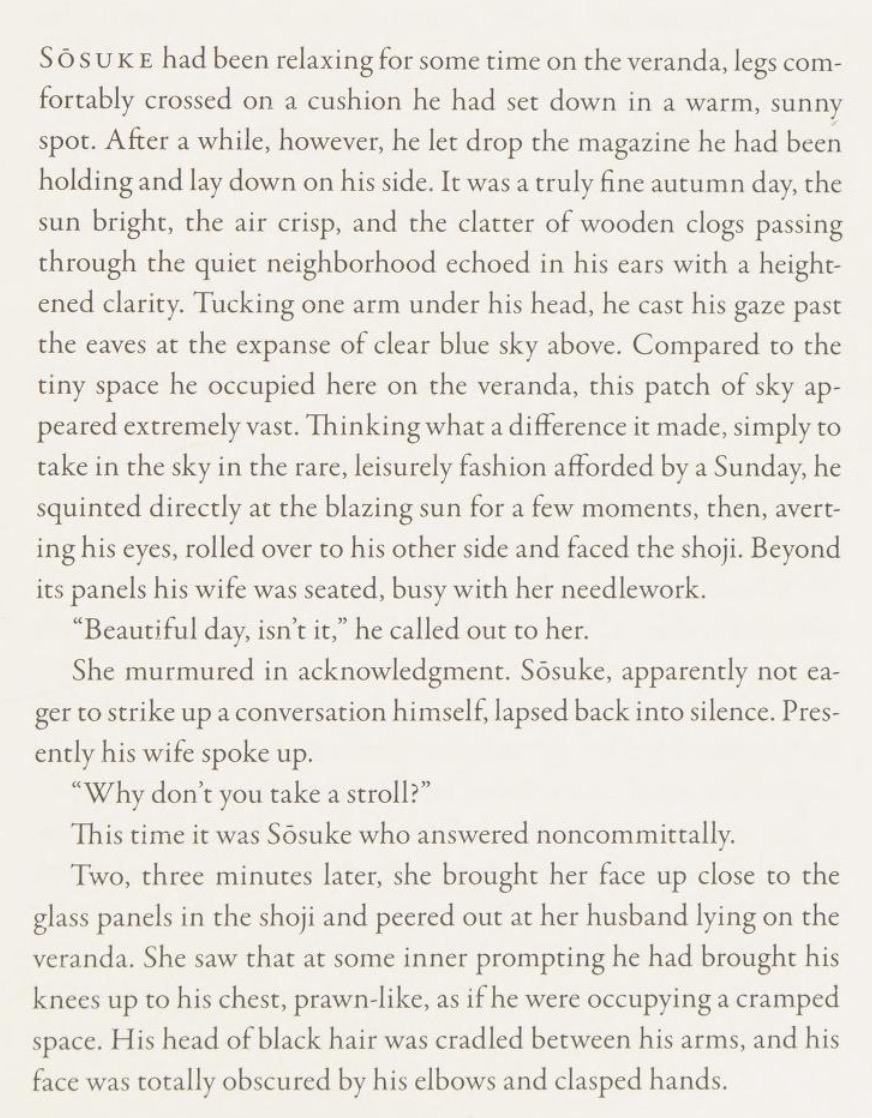
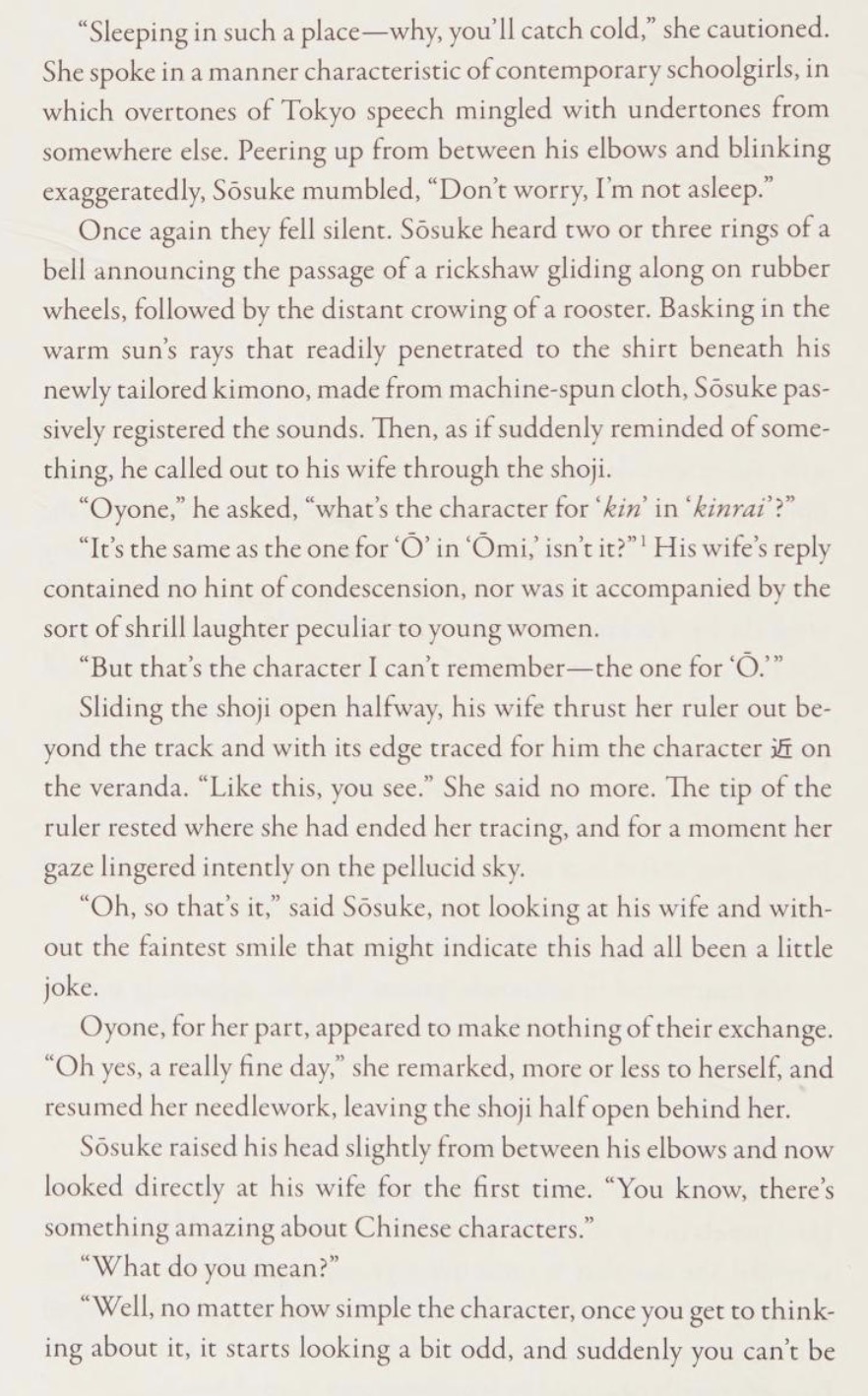
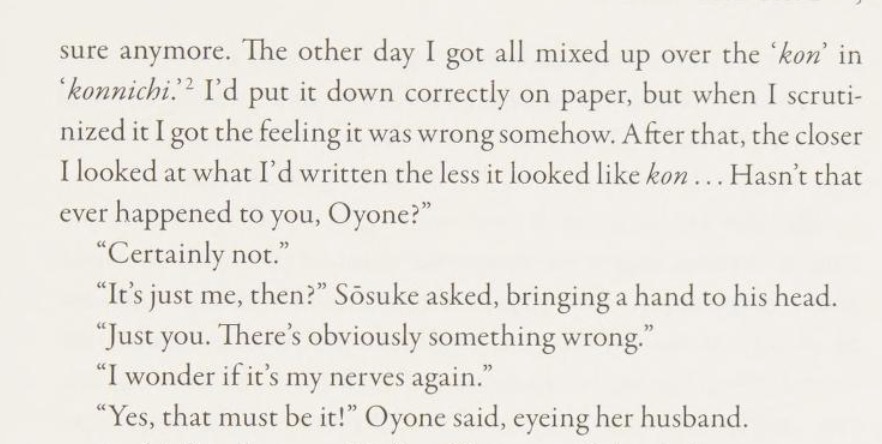
Translation by William F. Sibley (2013)