
Metal Rods for Exercise
I exercise with metal rods bought from industrial metal suppliers. As exercise devices, they are both simple and versatile. Here are some of the rods I use:

- Material: Solid stainless steel, carbon steel, or free-cutting brass
- Coating: None
- Shape: Hexagonal or cylindrical
- Diameter: 30, 35, 38, or 40 mm
- Length: Between 25 and 100 cm
- Weight: Between about 2 and 9 kg
Exercises
The exercises I do with them are inspired by Mark Wildman’s videos on YouTube about maces and heavy clubs as well as exercises using Indian clubs, Persian meels, and similar equipment that I have seen on social media. If I can get over my embarrassment, I might prepare a video showing some of the exercises I do with them.
These metal rods differ from maces and clubs as follows:
- The weight is evenly distributed along the entire length of the rod, so there is less inertia from the club’s weight when swinging. I like that because there is less stress on my wrists and because I can control the rods’ motion more easily. However, that straightness also places a limit on the maximum weight they can have while still having a reasonable length.
- Because the rods can be grasped anywhere, it is easy to adjust the inertial load while they are in use. A rod can also be passed easily from hand to hand—behind the back, under the legs, over the head, etc.—making it easier to do continous flowing exercises.
I exercise indoors on a hardwood floor with the ceiling not far above my head, so it wouldn’t be feasible for me to swing rods longer than a meter or so. A man named Lawrence Whitmore has an excellent website and book with complete information about using longer rods; the site was created about twenty years ago, and I haven’t been able to find any videos of him or others demonstrating the exercises. Mark Wildman does have a few videos about using similar metal staffs.
I have mostly used only one rod at a time, holding it in either one hand or both depending on the weight, length, and move. However, about eight months after I started exercising with single metal rods, I got interested in trying Indian club exercises as well, and I signed up for Monica Boldt’s Foundations course. Regular Indian clubs would hit the ceiling of my room during some of the moves she demonstrates, so I ordered the following pair of cylindrical metal rods to use instead:

They are 285 mm long—short enough not to hit my ceiling—and 34 mm in diameter, and they weigh slightly over 2.0 kg each. The balance is a bit different from traditional Indian clubs, but these short metal rods work fine for most—but not all—Indian club moves.
Pairs of heavier metal rods could be used with other types of exercises as well, such as the double-club exercises demonstrated by Dan Clay at Dangerously Fit.
Sourcing
I buy the rods from industrial metal suppliers that I find online with search terms like hexagonal metal rod, cylindrical steel bar, etc. I buy from suppliers in Japan, where I live.
I like stainless steel the most, though the less-expensive carbon steel and brass work just as well. Carbon steel and brass leave a metallic odor on my hands, however. Because brass contains lead, I am a little nervous about using it with bare hands for long periods. Carbon steel and brass will also presumably rust or corrode over time. I have used mine only indoors with dry hands, and I have not observed any discoloring yet.
The hexagonal rods are easier for me to hold firmly, while the shiny stainless-steel cylindrical ones are aesthetically pleasant to use and look at. I like both shapes.
I have large hands, and I prefer the 35 to 40 mm diameters. People with regular-size hands might do better with 30 mm. A smaller diameter means less weight relative to length, of course.
The diameter measurement of hexagonal rods is the distance between facing sides, not between opposite corners. As a result, a 35 mm cylindrical rod feels slightly smaller in the hand than a 35 mm hexagonal one does.

Suppliers offer metal rods in many diameters, and I have been able to order them in 1 mm increments of length.
Important safety notes
Swinging heavy metal rods is potentially very dangerous and should be done only with proper precautions. Be especially careful not to use them around small children or animals.
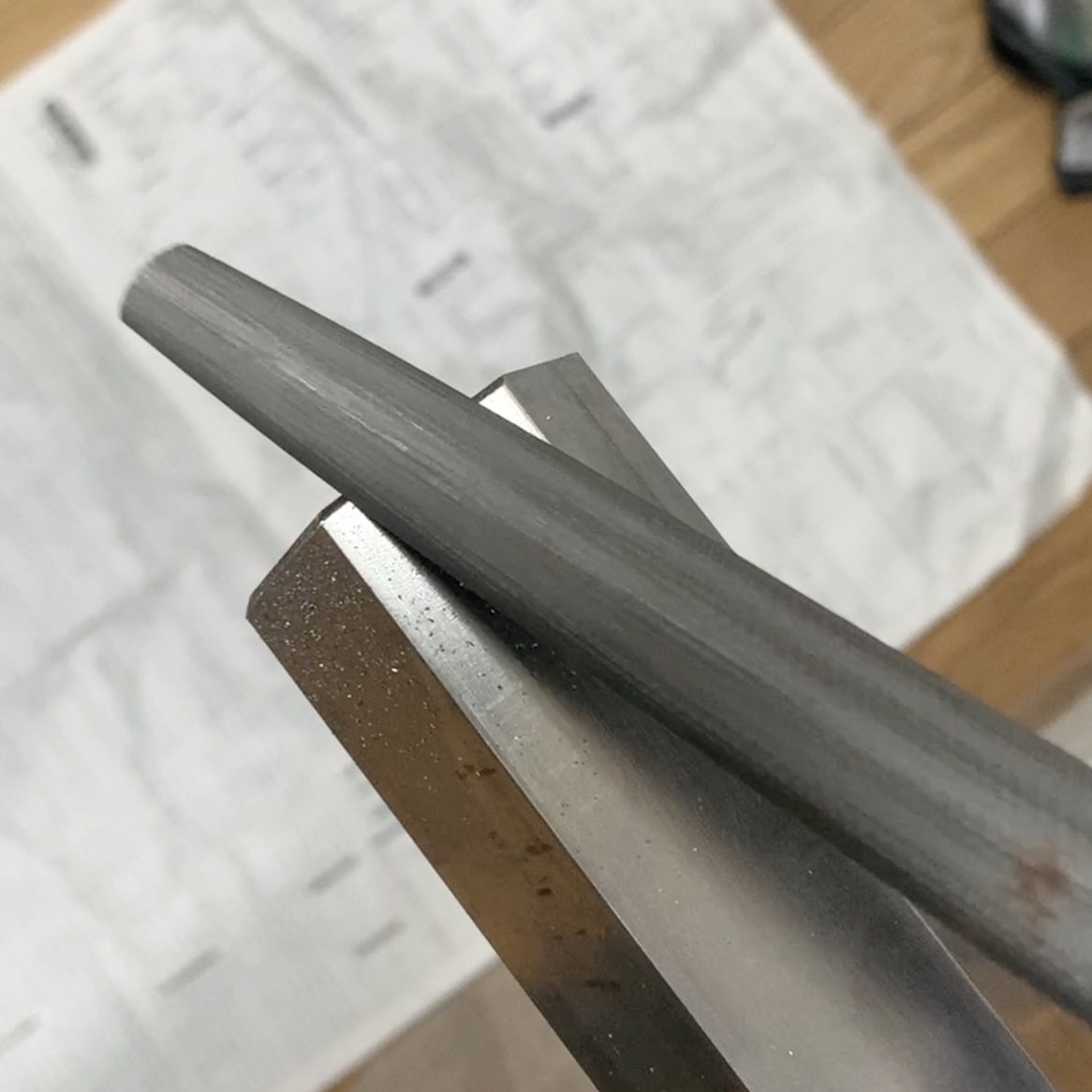
The rods can be used as-bought with no coating or gloves. However, you must round off the edges at both ends with a metal file or grinder, because the sharp edges on the unrounded ends can cause injury if they brush against the skin. I had not used a metal file since junior high school, more than fifty years ago, but I was able to file my metal rods effectively and safely after watching some instructional videos on YouTube.
Updated: May 17, 2023